
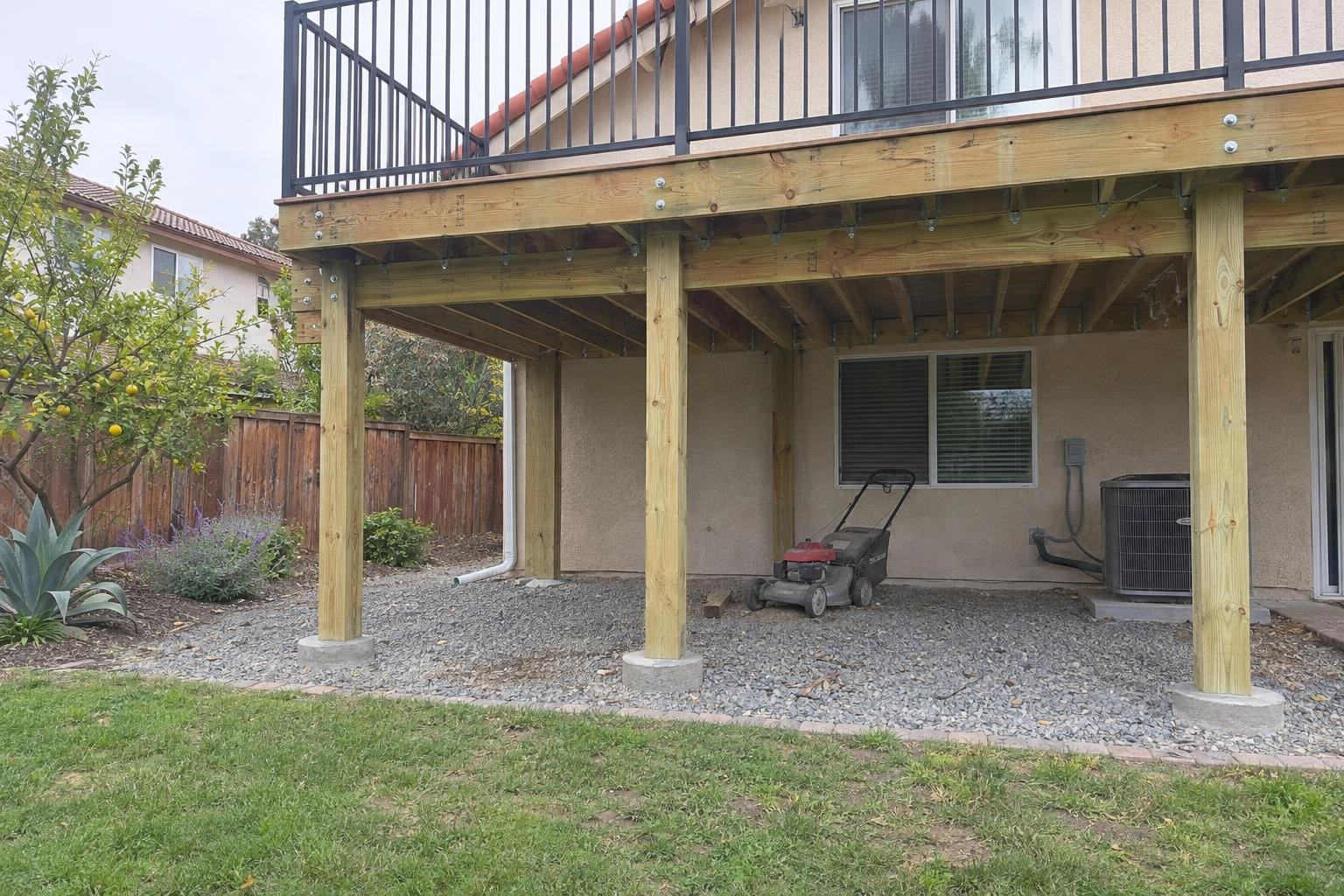
A deck looks simple once it's finished. Boards, rails, maybe a pergola over the top. What you can't see once it's built is the ledger board bolted to your house, the footings buried below grade, and whether the joists were spaced to actually hold the load you plan to put on them. Most of the deck failures I've seen, and the ones that make the news after someone's Fourth of July party goes through the floor, trace back to one of those three hidden things. So when you're picking a builder, the questions that matter are the ones about what you won't see.
Check the license, and actually check it
In California, any job over $500 in combined labor and materials requires a licensed contractor. Ask for the CSLB number and look it up yourself on the state's website. It takes two minutes and it tells you whether the license is active, what class it's under, and whether there are complaints or bond issues on file. A builder who hesitates when you ask for this, or waves it off with "I've been doing this for years," is telling you something. Years of experience with no license on file means years of work with no state oversight on it either.
Ask about insurance too, specifically general liability and workers' comp. If a framer falls off a ladder on your property and the company has no comp coverage, that liability can land on you as the homeowner.
Permits aren't optional, and in Corona they follow a pattern
Decks attached to a house, over a certain height off grade, or over a certain square footage need a permit through the City of Corona's building division. A reputable builder pulls it, doesn't ask you to pull it yourself to save time, and doesn't suggest skipping it because "nobody checks." Someone does check, usually when you go to sell the house and the buyer's inspector asks for permit history on an uncovered deck.
The process typically involves a plot plan showing the deck's location relative to your property lines, since setback rules still apply even to a structure with no walls. Inspections usually happen twice: once at the post holes, before any concrete goes in, so the inspector can confirm footing depth and rebar placement, and again at framing, before the decking boards go down and hide the joists and hardware. If your builder's schedule has the concrete poured the same day they dig the holes, there was no inspection in between. If you're in one of Corona's newer subdivisions, Eagle Glen or Sierra del Oro for example, your HOA likely has its own architectural review on top of the city permit, covering things like railing style and stain color. Check your CC&Rs before you fall in love with a design.
What Corona's soil and sun actually do to a deck
A lot of the ground in this part of Riverside County has a clay content that swells when it's wet and shrinks hard when it's dry. That movement happens seasonally, heavier in the wetter months of December through February and tightest in the dry heat of summer. A footing that only goes 10 or 12 inches down can sit right in that active zone and heave or settle a little every year. Most deck footings here need to go deeper, often 18 to 24 inches depending on the soil report for your lot, to get below where the clay is doing most of its moving. A builder who gives you a footing depth without having looked at your actual soil, or who just says "we always do 12 inches," hasn't adjusted for your lot.
Summer heat is the other factor people underestimate. Corona regularly sits in the 95 to 105 degree range from July through September. That's hard on sealants and stains, which cure faster than labels suggest and can crack or peel sooner than they would in a cooler, damper climate. If you go with real wood, redwood or cedar or pressure-treated, plan on resealing every two to three years instead of stretching it to four or five like you might read on a product label written for a different climate. Composite decking skips that maintenance cycle entirely, which is part of why it's gotten popular here, though it costs more up front and can still fade a shade or two in direct, unshaded sun over the years.
Older streets versus newer subdivisions
Houses in the older parts of Corona, South Corona and the Circle City area for instance, sometimes have additions and decks that were built before current code, or built without a permit at all. If your existing deck or patio structure is one of these, a builder worth hiring will actually get under there and look at the ledger attachment and the condition of the rim joist before quoting a repair or a resurface. Lag screws into a rotted rim joist don't hold any better than they did the first time. In newer subdivisions built from the 1990s onward, the framing underneath is usually more standardized, but that doesn't mean every builder followed the prescriptive span tables correctly. Ask what joist spacing they use, 16 inches on center is standard for most decking materials, and ask what size posts they're specifying. A 4x4 post might be fine for a low deck with a light load, but anything over a few feet off grade, or anything carrying a pergola or roof structure, generally needs a 6x6.
Red flags worth walking away from
- A bid that's dramatically lower than two or three others with no explanation. Someone is cutting a corner, usually the footings or the hardware, since lumber costs are roughly the same for everyone buying from the same suppliers.
- No written contract, or a contract that doesn't specify materials by name and grade. "Composite decking" isn't a spec. Which brand, which board profile, what the hidden fastener system is, that's a spec.
- Reluctance to pull a permit, or a suggestion that you do it yourself.
- Vague answers about ledger flashing. The ledger is where the deck bolts into your house, and it needs proper flashing to keep water from working its way behind your siding. If a builder can't explain how they'll flash it, they may not have thought about it.
- No mention of your soil or your lot's drainage at all. A builder who quotes footing depth and post spacing without ever asking about your yard is quoting a generic deck, not yours.
A good deck builder in Corona should be able to talk through all of this without being asked twice, the permit process, the footing depth for your particular lot, the maintenance schedule that actually fits our summers. If you want to see how we handle that conversation and what a project actually looks like from permit to finished rail, take a look at our deck builder work around Corona and the surrounding towns.